.png)
.png)
.png)

HIPAA Data Destruction Requirements for Healthcare IT Equipment

Every piece of equipment that retires from a healthcare organization carries very sensitive information, such as patient details, hospital records, employees’ personal information, etc. HIPAA data destruction requirements exist primarily to protect such information. Even if you delete a file or reformat a drive, it doesn't ensure that the data cannot be recovered; today's forensic tools can easily recover data from such devices.
If that equipment leaves your facility without proper data destruction, you need to face the consequences of a HIPAA violation, no matter what your intent was. Therefore, we cover everything in this guide, including what HIPAA data destruction actually is and what documentation you need to prove compliance in case of sudden audits, and also the important instructions you should follow to avoid any type of mishap.
What Counts as Healthcare IT Equipment Under HIPAA
HIPAA destruction rules are not limited to specific electronic equipment; they are concerned with any device that stores, processes, or transmits electronic protected health information (ePHI)
HIPAA covers
Servers, laptops, desktop computers
Hard disks, solid disk drives
All medical devices with data storage, i.e., patient monitors, MRI, CT, copiers, printers, and multifunction devices
Memory cards, tablets, machines, and cloud storage that has the patient's information
Backup plates and removable media
Any device that is ever exposed to ePHI falls under HIPAA after it is retired. For example, any laptop used by the doctors to study the progress of treatment or disease or any printer or scanning IT equipment that is used to copy or scan the report may store the information in its internal drive for long enough that you barely remember it are included in this cateory.
The devices that fall under HIPAA are therefore concerned with the patient's data, NOT the device itself. Treating "IT equipment" in routine cleanouts by following a certain method is necessary so that the data is not restored or recovered by any means afterwards.
What HIPAA Actually Requires for Data Destruction
HIPAA itself doesn't provide you with any type of approved tools or techniques for data destruction. Still, instead it gives you a criterion that you have to fulfill by following any data destruction method, whether by NIST 800-88 standard techniques or internal documented procedures.
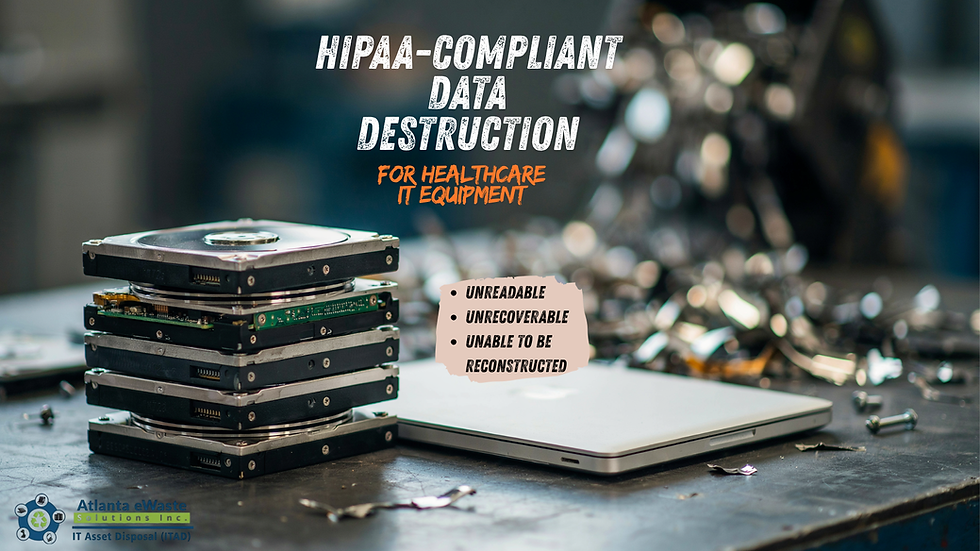
Therefore, HIPAA security and privacy rules set a standard that any device containing ePHI must be unreadable, irrecoverable, and unable to be reconstructed before it leaves your facility or control. This standard applies to covered entities directly and to all businesses handling the disposal of such devices.
Also, the HHS guidance on disposal of protected health information reinforces the same principle and focuses more on results than the methods. As HHS doesn't provide equipment-specific guidelines, most of the healthcare IT teams find it problematic because the terms “unreadable" or "unrecoverable" look very different on a hard disk drive than they do on a copier or old server.
Moreover, there is another thing that is worth notifying that: whenever you hire an outside vendor for data destruction, that company is referred to as a business associate under HIPAA. That’s why you must have a business associate agreement (BAA) in hand before you hand over the equipment to the second party. Without the BAA, your organization is still responsible if anything goes wrong during disposal. Simply hiring a vendor for data destruction and responsible disposal doesn't automatically protect you; you have to ensure compliance till the end.

Approved Methods for HIPAA-Compliant Data Destruction
There is not a single technique that applies to every situation to ensure destruction; the right choice depends on the device, its condition, or whether the device is going to be reused or recycled. The following methods are applicable to different devices depending on the owners' priorities and the type of information stored in it.
Certified data wiping:
In this method, software is used that overwrites every sector of a drive with random digits following a recognized standard—NIST 800-88.
This method is best suited for devices that are going to be resold, donated, or reused for other purposes. It securely erases the data while keeping the hardware intact, allowing the device to be used again easily. However, it is not generally recommended for devices with highly sensitive data where physical destruction is the preferred choice.
Physical destruction:
This method involves different techniques such as shredding, crushing, or disintegrating the drive. It permanently destroys the drives by shredding them into fragments that are impossible to reconstruct, eliminating the chances of recoverability.
Plus, as the devices cannot be reused, it mostly applies to devices with highly sensitive data or devices that are highly damaged and are recycled.
Degaussing:
It is another method to securely destroy data using a powerful magnetic field that scrambles the data on storage media devices. It is effective for older mechanical drives, but it doesn't apply to SSDs (solid-state drives), as they don't store data magnetically.
In short, wiping is enough for devices being deployed; physical destruction is best for devices reaching true end-of-life. Using both techniques together removes any doubts of recoverability entirely and ensures secure data removal.
Documentation Requirements: Certificate of Destruction & Audit Readiness
HIPAA-compliant data destruction or any other standard doesn't just give you instructions that you need to fulfill; they also need proof. A certificate of data destruction is a standard document that satisfies HIPAA audit requirements. This certification includes
Serial numbers or asset tags for each device destroyed
The method used (wiped, shredded, degaussed)
Date and location of destruction
Signature or verification from the vendor performing the work
This certification is what protects your organization if the HHS Office for Civil Rights ever audits how you dispose of equipment with ephi. Without this, you can only tell them you intended to destroy, not that you actually did. Even if you did it, the standards don't rely on verbal claims and need verifiable proof.
Moreover, the chain of custody is also essential if your equipment is travelling outside your facility and is being handled by a vendor. You need to provide documented record of custody at every step. Any gap in documentation affects the audit trail, and compliance cannot be confirmed, even if the destruction itself was performed correctly.
Secure Disposal of Portable Electronic Devices (PEDs)
Portable devices come with their own risk profile and pose greater risks than fixed it equipment for example, laptops, tablets, smartphones, and usb drives are easy to lose track of as they frequently contain cached ephi even when they are not the storage devices and are often overlooked when managing the secure data destruction procedures.
PEDs require the same standard as other equipment, i.e., data must be unreadable and unrecoverable, but it also requires tighter inventory controls. It is essential for every organization to produce a list of PEDs that ever touched patients' information; otherwise, you can't reliably confirm that all of the devices' data was properly destroyed. Always keep the PEDs in the same tracking and destruction workflow as your fixed assets are to eliminate any chances of non-compliance.

Common Mistakes That Violate HIPAA Data Destruction Rules
The following are a few common mistakes that violate the HIPAA data destruction guidelines.
Assuming a factory reset is sufficient.
Skipping documentation.
Overlooking secondary storage such as copiers, scanners, and networked printers.
Treating wiping and destruction as interchangeable
No chain of custody for offsite destruction
HIPAA data destruction requirements for healthcare IT equipment are strict, and all those above should be avoided by developing a complete HIPAA data destruction policy and covering every essential guideline in a required standard. Plus, choose a vendor carefully that applies all these guidelines to the process and provides proof of each step.
Finding a HIPAA-Compliant Data Destruction Service in Atlanta
For healthcare institutions in Atlanta, it is best to contact a local certified data destruction provider so your equipment doesn't have to travel far and is handled securely. It is best to demand on-site data destruction so that everything is handled inside your facility in front of you, including the data destruction and documentation, rather than just trusting a third party.
Atlanta eWaste Solutions provides HIPAA-compliant data destruction services with documented disposal of healthcare IT equipment. We also offer onsite data destruction and free pickup and drop-off services across Atlanta and Georgia. Therefore, if you are planning an equipment refresh or needs a disposal services at larger scale, you can always reach out to us and discuss your equipment inventory and destruction needs.


Comments